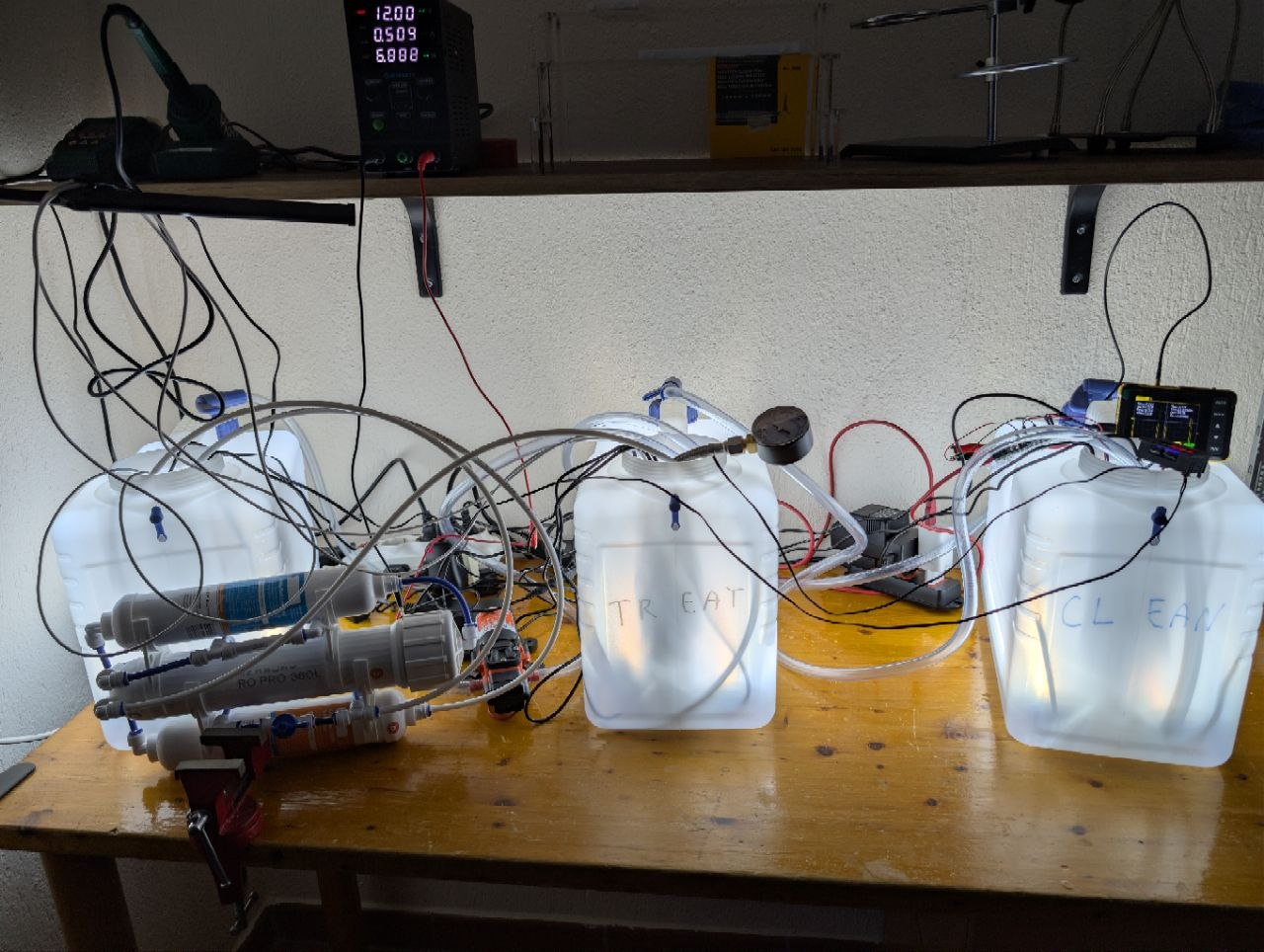
The bench I designed and built
My technical work includes designing and building the Aqua Vitaque experimental water-treatment bench. The assembly brings together feed, treatment and clean-water reservoirs, pumping, reverse osmosis hardware, fluidic connections, an inline pressure gauge, sensing and local electronics. The original photograph documents the physical assembly.
An accessible bench makes the process pathway visible. It provides a practical setting for inspecting connections, modifying configurations and relating instrument readings to the state of the equipment. Reverse osmosis is the current experimental reference; forward osmosis and additional membrane architectures belong to the continuing research program.
Instrumentation and IoT development
The monitoring work connects physical observations with their operating context and the software needed to interpret them. The development agenda includes measurement acquisition, sensor calibration, local data handling, anomaly interpretation and interfaces that help an operator inspect the process. Instrument identity, time and operating state should remain attached to each observation.
AV Sentinel is the proposed local intelligence and evidence layer. Its development connects process and optical signals with probabilistic models, uncertainty and operator review. The technical objective is to make the path from a measurement to a decision inspectable, including cases in which the evidence is insufficient or inconsistent.
Membrane research and physical diagnostics
I am a coauthor of a 2026 Membranes article on a hierarchical diagnostic framework for heterogeneous forward osmosis membranes. That work connects transport behavior with structural and operating conditions. It provides scientific context for asking which observations reveal a change in the process and which additional measurements would help explain it.
For an experimental configuration, the next measurements would document hydraulic and mass balances, electrical consumption, membrane behavior and paired water-quality observations. These are defined experimental questions rather than performance numbers inferred from the photograph. The combination of physical assembly and computational interpretation is the central technical contribution.
Retrofit concepts for existing assets
My retrofit work explores how existing treatment assets can benefit from improved monitoring and process choices. An initial assessment identifies available measurements, physical interfaces, operating constraints and the points at which a targeted modification can produce useful information or improve operation.
The proposed evaluation compares a documented baseline with a controlled modification and records the effect on the agreed process indicators. It includes maintenance access, operator understanding and the ability to return to the earlier configuration. These are development concepts for integration studies, with site-specific requirements to be established before installation.
Contribution to technical research teams
This work demonstrates practical integration of physical components and experience reasoning about a measured process. The transferable skills include following an equipment pathway, connecting observations to operating states, investigating anomalies and developing software that supports technical decisions. My programming work in Python and C# complements the experimental hardware work.
The quantum research provides a complementary measurement and computing perspective. The executed QAOA sampling study examines how a measurement budget affects precision, while the AI calibration study separates ranking from probability reliability. Both publish reproducible computational records that can be inspected alongside this physical systems case study.
Sources & scientific context
Author
Maurizio VivianiIndependent research · Robotics
Take one question into an experiment.
Discuss a focused research collaboration, benchmark or implementation study.
Discuss this direction