Abstract
A hybrid quantum workflow needs a measurement budget as well as an algorithm. This note studies the sampling error of a fixed-angle, four-qubit QAOA circuit with an exact classical reference. Across 2,000 repeated estimates at each shot budget, measured root mean squared error follows the variance-based prediction. The experiment provides a small, inspectable example of how an uncertainty target can become a resource requirement.
1 / The scientific question
How many measurements does a computation need before its output is precise enough for a downstream decision? Counting circuit executions alone does not answer that question. The distribution of the observable matters: two circuits with the same expected value can require different sampling budgets.
The working proposition is to treat statistical precision as an explicit interface between the scientific question and the execution system. A requested standard error becomes a planned number of independent samples, with the model assumptions recorded beside the result.
2 / Model and reproducible method
The circuit implements the published p = 1 QAOA construction for MaxCut. The graph contains four vertices and five unit-weight edges: (0,1), (1,2), (2,3), (3,0) and (0,2). All sixteen bit strings are enumerated, giving an exact optimum of four cut edges. An ideal statevector supplies every output probability.
A 51 × 51 angle grid selects the circuit before sampling. Gamma ranges from 0 to π and beta from −π/2 to π/2. With those angles fixed, the program draws multinomial counts at 64, 256, 1,024 and 4,096 shots, with 2,000 independent estimates per budget. The random seed is 20261011. These are classical simulations of ideal measurement statistics.
Scientific context: [1]
3 / Executed results
The selected circuit has exact expected cut 3.236986, variance 0.449977 and optimal-cut probability 0.327662. Gamma = 0.565487; beta = 0.314159. The grid selects its best sampled point, not a certified continuous-angle optimum.
SE(C̄) = √(Var(C) / N)
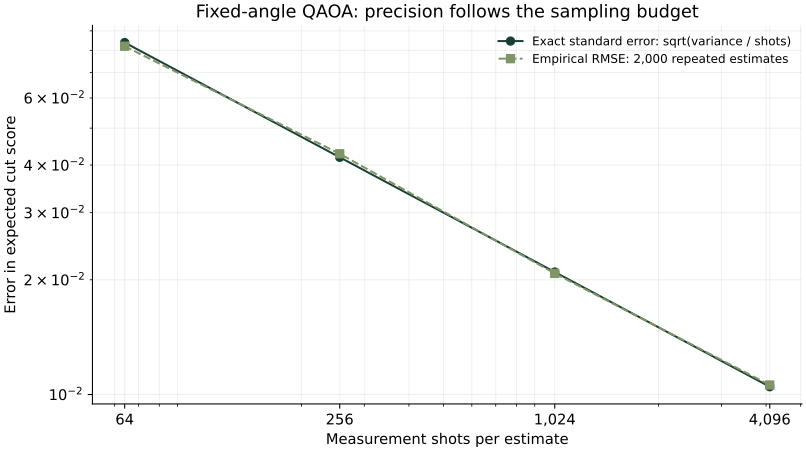
Shots | Empirical RMSE | Predicted standard error | Empirical bias |
|---|---|---|---|
| 64 | 0.082030 | 0.083850 | -0.001509 |
| 256 | 0.042824 | 0.041925 | -0.001043 |
| 1,024 | 0.020787 | 0.020963 | -0.000154 |
| 4,096 | 0.010592 | 0.010481 | -0.000107 |
4 / Precision becomes a resource constraint
For independent samples of the cut score C, the variance of the sample mean is Var(C)/N. In this experiment, multiplying the shot count by four halves the predicted standard error. Reaching eight times better precision requires sixty-four times as many samples when the variance stays fixed. The observed RMSE values closely track that prediction.
A useful planner can invert this relationship: N ≥ Var(C)/ε² for a target standard error ε. This is a standard-error requirement, not a confidence guarantee or a bound on systematic error. Hardware noise, correlated samples and mitigation bias require additional terms. Optimization itself also consumes samples when its objective is estimated rather than computed exactly.
5 / Relevance to scientific hybrid computing
CERN QTI describes quantum processors as components of larger classical workflows and identifies systematic benchmarking as a research activity. The connection proposed here is to report precision alongside resource consumption, so a small quantum result can be evaluated inside the full scientific computation.
The next experiment would replace the fixed-angle ideal circuit with noisy execution, then compare a fixed-shot policy with a prespecified precision-driven policy. Evaluation would include total shots, objective calls, wall-clock components and the reliability of the final estimate. The present four-qubit study establishes a transparent reference for that extension; it does not measure hardware performance.
6 / Reproduce and inspect
The Python source, full-precision JSON and CSV table are available below. The implementation records the graph, angles, probabilities, variance, seeds and dependency versions. Its exact expectation was cross-checked against the separately implemented browser laboratory to floating-point precision.
python -m pip install numpy==2.3.5 matplotlib==3.10.8
python reproduce_research.py --output-dir results
References
Author
Maurizio VivianiIndependent research · Robotics
Develop the next experiment.
Discuss scientific benchmarking, hybrid computing or a reproducible evaluation study.
Discuss a research collaboration